

Starting kindergarten is a big step for little ones and their families. In Australia, these early learning groups focus on playful discovery while building skills for lifelong success. Think of it as your child’s first taste of structured school life – but with plenty of laughter and creativity mixed in!
Most states offer kindergarten programs for kids aged 3-5, with class sizes varying between 15-22 children. Whether you’re in NSW, Victoria or Queensland, educators use play-based learning to help young minds grasp basics like counting, letter recognition and teamwork. These sessions aren’t just about ABCs – they’re where friendships bloom and curiosity grows.
Recent data shows 92% of Aussie kids attend kindergarten, proving how valued this foundation year is. The curriculum balances storytelling, art and outdoor adventures with gentle introductions to numbers and words. Parents often notice huge leaps in their child’s confidence and problem-solving skills during this special time.
Key Takeaways for Aussie Families
- Kindergarten programs differ slightly between states but share common learning goals
- Class sizes typically range from 15-22 children per educator
- Play-based activities build both academic readiness and social skills
- 93% of educators report improved communication skills in attendees
- Most programs include transition support for first-time school experiences
Introduction to Kindergarten Experiences in Australia
Stepping into the vibrant world of early learning marks an exciting milestone for Australian families. This foundational year blends playful exploration with gentle structure, helping children aged 3-5 develop skills that ripple through their entire school journey. From Sydney to Perth, state guidelines ensure every program nurtures curiosity while preparing young learners for formal education.
Overview of the Kindergarten Journey
Little ones experience their first year of structured learning through hands-on activities and collaborative play. Parents often describe it as watching their child unlock new superpowers – sounding out words during storytime or proudly counting toy dinosaurs. Teachers craft environments where finger painting and number games sit alongside early reading exercises, ensuring progress feels like adventure.
Context and Importance in Early Childhood Education
Australia’s focus on early childhood education stems from proven long-term benefits. Studies show children who engage in quality programs develop stronger communication skills and emotional resilience. Each state tailors its curriculum slightly – Victoria emphasises outdoor exploration, while Queensland integrates more music-based learning – but all prioritise social growth alongside academic basics.
As one educator puts it: “This isn’t just about letters and numbers. It’s where kids learn to navigate friendships and solve problems – skills that shape their entire lives.” For families, it’s heartwarming reassurance that their child’s first year of structured learning plants seeds for lifelong success.
Exploring the Core Curriculum for Young Children
Australian early learning programs weave together academic foundations and creative discovery. Educators design experiences where literacy and numeracy grow alongside artistic expression and scientific curiosity. This approach helps children connect classroom learning to real-world wonders.
Focus on Language, Literacy and Numeracy
Little learners master basics through playful repetition and multi-sensory activities. Teachers use rhythm-based sight words games and counting songs to build confidence. One educator shares: “We turn letter recognition into treasure hunts – it’s amazing how quickly they absorb phonics when it feels like play!”
Daily routines blend structured teaching with self-paced exploration. Interactive whiteboards might display animated alphabet stories, while tactile number puzzles reinforce early maths concepts. These methods ensure each child progresses without pressure.
Incorporating Science, Social Studies and Creative Arts
Budding scientists explore weather patterns using DIY rain gauges, while future artists mix colours during messy-jacket painting sessions. Group projects about community helpers teach teamwork and cultural awareness. Social emotional skills flourish as kids negotiate roles in pretend-play scenarios.
The curriculum cleverly links subjects – counting becomes music beats, science experiments inspire descriptive storytelling. This holistic approach keeps young minds engaged while preparing them for formal schooling. Parents often marvel at how their child naturally applies classroom learning during family outings or playdates.
classes in kindergarten: Building Foundational Skills
Young learners thrive when programs balance skill-building with joyful discovery. Australian educators craft experiences that strengthen both social emotional growth and physical coordination, creating confident problem-solvers ready for life’s adventures.
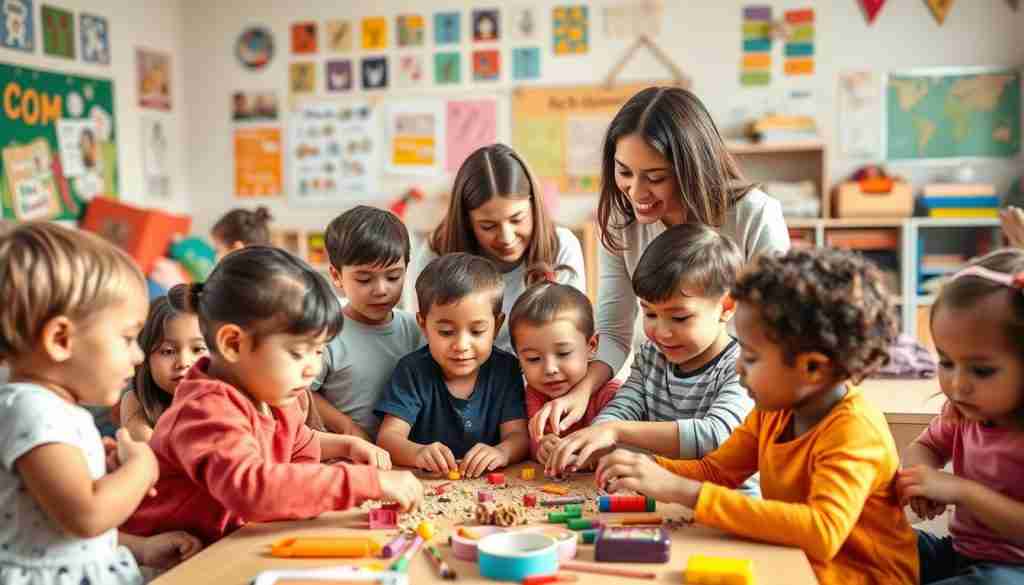
Developing Social and Emotional Skills
Daily group activities teach cooperation through shared goals. Role-playing scenarios help kids navigate emotions – like using puppet shows to practice sharing or conflict resolution. “We celebrate ‘kindness moments’ to reinforce positive interactions,” explains a Melbourne educator.
Structured routines build emotional resilience. Morning check-ins let children express feelings using emotion cards. Collaborative art projects encourage patience and turn-taking. These techniques lay groundwork for healthy relationships.
Enhancing Fine Motor and Cognitive Abilities
Skill-building happens through play:
| Activity | Skills Developed | Real-World Link |
|---|---|---|
| Bead threading | Hand-eye coordination | Writing readiness |
| Pattern blocks | Spatial reasoning | Maths concepts |
| Playdough sculpting | Finger strength | Tool manipulation |
Recent University of Sydney research shows children with strong fine motor skills at age 5 score 18% higher in Year 2 literacy tests. Educators use this data to design targeted activities like tweezers games for object sorting.
Parents can extend learning through simple home practices. Sorting laundry by colour or helping measure ingredients boosts cognitive development naturally. When families and educators team up, children build unshakable foundations for lifelong learning.
Engaging Activities and Play-Based Learning
Laughter echoes through learning spaces as young minds discover through play. Australian educators craft activities that turn abstract ideas into tangible adventures, proving that fun and growth go hand-in-hand. Research shows playful exploration boosts memory retention by 34% compared to traditional methods – a win for both smiles and skill-building!
Interactive Learning Games and Hands-On Tasks
Educators transform literacy and numeracy into thrilling quests. Picture fun games like “Alphabet Obstacle Course”, where kids hop on letter mats while sounding out phonics. One teacher shares: “When we made number bonds with building blocks, even reluctant learners joined the group excitement!”
These hands-on approaches work wonders:
| Activity | Skills Developed | Play Focus |
|---|---|---|
| Sensory Number Hunt | Counting & Sequencing | Texture Exploration |
| Rhyme Memory Match | Phonemic Awareness | Pattern Recognition |
| Storytelling Puppet Theatre | Vocabulary Expansion | Collaborative Creativity |
Small group projects like constructing cardboard towns teach cooperation. Children negotiate roles – “You be the builder, I’ll make the signs!” – while applying measurement concepts. Such class activities create natural moments for problem-solving and peer learning.
The magic lies in balancing structure with spontaneity. Whether mixing “volcanoes” with baking soda or sorting storybook characters, every child finds joy in discovery. As one parent remarked: “My daughter now sees maths in cloud shapes – that’s learning fun at its best!”
Supporting Your Child’s Learning at Home
Your living room can become a powerful learning space with simple tweaks. Australian parents often wonder how to reinforce classroom skills without formal lessons – the secret lies in weaving education into daily moments. Let’s explore practical ways to nurture growth through everyday interactions.
Creating a Literacy-Rich Environment
Transform your home into a language playground. Stick colourful labels on household items – “fridge”, “bookshelf” – to boost word recognition. Dedicate a cosy reading nook with age-appropriate books rotated weekly. Reading aloud together for 15 minutes daily builds vocabulary and bonding time.
| Activity | Skills Developed | Parent Tip |
|---|---|---|
| Grocery list helpers | Letter recognition | Ask your child to spot “T” labels on tins |
| Story prediction games | Comprehension | “What happens next?” pauses during reading |
| Name tracing in sand | Writing readiness | Use a baking tray for mess-free fun |
Fun Math and Problem-Solving Practices
Turn snack time into maths adventures. Ask your child to sort blueberries into groups of three or compare carrot stick lengths. These playful challenges develop logical thinking while keeping learning relaxed. Cooking together offers perfect time to explore measurements – “Let’s count how many cups fill the bowl!”
Strengthen motor skills through creative play:
- Use chopsticks to transfer cotton balls (fine motor practice)
- Create obstacle courses with couch cushions (gross motor development)
- Thread pasta necklaces while counting beads (dual skill-building)
Remember, short 10-minute sessions work best for young minds. As one Gold Coast parent shares: “Our kitchen maths games make learning feel like special time together, not homework.” Celebrate small wins – every counted step or recognised street sign builds confidence!
Understanding the Classroom Environment and Daily Routines
Sunlight streams through classroom windows as little learners embark on their daily adventure. Australian early education spaces buzz with predictable rhythms that comfort children while sparking discovery. Visual timetables with colourful symbols help young minds grasp what comes next – a clever blend of structure and flexibility.

Typical Daily Schedules and Routines
Mornings kick off with welcoming rituals: signing in with name cards and sharing news. Literacy blocks dominate early hours when energy peaks, using songs and interactive stories. Teachers divide time wisely – 20-minute bursts for phonics, then movement breaks to wiggle and recharge.
After recess fruit snacks, groups rotate through hands-on stations:
- Science explorers examining leaf patterns
- Maths detectives sorting shape puzzles
- Story builders creating puppet show scripts
Lunchtime isn’t just about sandwiches – it’s social skill practice. Educators model polite conversations while children learn to open containers independently. Afternoons blend creative arts with outdoor investigations, winding down with reflection circles before hometime.
“We use transition songs to shift between activities smoothly,” shares a Brisbane teacher. Information boards display real photos of daily steps, helping children feel secure. Parents appreciate how these routines build responsibility – from packing bags to following visual cues.
Balanced schedules work magic. Morning challenges sharpen focus, while collaborative afternoons nurture friendships. As one mum observed: “The predictable pattern helps my child transition happily between home and schools.” This thoughtful flow ensures every day brings growth wrapped in joy.
Teacher Insights and Resourceful Planning
Behind every thriving early learner stands a teacher with a toolbox of creative strategies. Australian educators blend research-backed methods with playful innovation, crafting lessons that spark curiosity across all learning areas. Their secret? Planning that adapts to each child’s needs while keeping the classroom buzzing with discovery.
Effective Lesson Planning and Instruction Strategies
Seasoned teachers design lessons using “thematic weaving” – connecting maths to nature walks or literacy to puppet shows. One Sydney educator shares: “We turn phonics into treasure hunts and number bonds into building challenges. When kids don’t realise they’re learning, that’s when the magic happens!”
Key approaches making a difference:
- Flexible grouping: Mixing abilities during activities to encourage peer learning
- Multi-sensory stations: Rotating between tactile, visual and auditory tasks
- Learning stories: Documenting progress through photos and child-led narratives
These methods address varied knowledge levels while keeping the class level engaging. A Melbourne teacher explains: “Our dinosaur week had kids measuring fossil replicas (maths), writing excavation reports (literacy), and creating clay habitats (science). Every child found their entry point.”
| Strategy | Creative Twist | Skills Targeted |
|---|---|---|
| Story-based maths | “Rescuing” numbered toys from a “volcano” | Problem-solving & counting |
| Science-art fusion | Mixing colours while discussing light refraction | Observation & experimentation |
| Role-play literacy | Post office drama with letter-writing | Vocabulary & social skills |
This thoughtful teaching approach helps children grasp concepts through multiple lenses. Parents often notice how classroom strategies ripple into home play – like kids reenacting science experiments or inventing their own number games. As research confirms: when teachers plan with flexibility and flair, learning becomes an adventure every child wants to join.
Enhancing Social, Communication and Group Skills
Shared laughter fills the air as little learners navigate their first collaborative challenges. Australian early learning spaces transform everyday moments into opportunities for connection, where social emotional skills grow alongside giggles and glue sticks. These experiences lay groundwork for healthy relationships that extend far beyond classroom walls.
Building Positive Friendships and Teamwork
Educators design group tasks that require cooperation and creative problem-solving. Picture students working together to build cardboard castles – negotiating roles, sharing materials, and celebrating joint successes. One Melbourne teacher notes: “When children create something as a team, they learn compromise is sweeter than winning alone.”
Classroom activity rotations might include:
- Buddy reading pairs taking turns as storyteller and listener
- Collaborative mural projects where each child adds unique elements
- Role-play scenarios practicing conflict resolution with puppets
These interactions teach valuable life lessons. During snack time, students practice patience while waiting their turn. Outdoor games become laboratories for testing fairness rules. Educators gently guide discussions when disagreements arise, helping children articulate feelings respectfully.
The magic lies in making skill-building feel like play. A Sydney educator shares: “We turn sharing practice into ‘kindness challenges’ – kids beam when earning smiley stickers for including others.” This approach helps young minds associate positive social habits with joy rather than obligation.
Foundational experiences in childhood education ripple through a child‘s entire life. Research shows students who develop strong peer skills early are 42% more likely to form healthy friendships in primary school. By nurturing empathy and communication today, we equip little Australians for tomorrow’s big adventures.
Conclusion
The final year before formal school blossoms with growth opportunities. Australia’s early learning programs blend structured routines with creative exploration, nurturing children’s curiosity and confidence. Through play-based activity and guided discovery, young minds build essential knowledge while mastering social and fine motor skills.
Consistency between classroom and home environments amplifies development during these formative years. Simple practices like counting during play or discussing storybooks reinforce classroom learning. Educators emphasise age-appropriate challenges that stretch abilities without overwhelming – whether threading beads or collaborating on group projects.
While each state tailors its approach, all programs share core goals: sparking joy in discovery and preparing children for future school success. Parents and teachers working together create a safety net where every child thrives.
These early years lay groundwork for lifelong curiosity. With caring support, young learners step forward with the skills and enthusiasm needed to embrace tomorrow’s adventures. What begins as finger paints and friendship circles grows into unshakable foundations – Australia’s greatest gift to its youngest citizens.