
Ever noticed how young minds light up when they’re curious? Hands-on activities that blend fun with foundational skills can turn everyday play into powerful learning moments. This guide highlights creative tools designed to nurture problem-solving, logical thinking, and creativity in children aged 5–12.
We’ve carefully selected products praised by experts like Good Housekeeping and trusted by Aussie families. For example, the LeapFrog Learning Hamburger introduces sequencing through pretend play, while the VTech Activity Wagon mixes storytelling with basic engineering concepts. These aren’t just gadgets—they’re gateways to exploring science, tech, and maths without feeling like “homework”.
Our list focuses on age-appropriate options, from beginner-friendly coding kits to advanced robotics projects. You’ll find clear details about skill development, safety standards, and why brands like SwitchedOnToys stand out in creating engaging educational tools.
Key Takeaways
- Play-based learning builds critical thinking and teamwork skills
- Trusted brands ensure quality and educational value
- Age-specific recommendations help match toys to development stages
- Real-world applications make abstract concepts relatable
- Parent-friendly guides simplify decision-making
Introduction to STEM Toys for Primary School Kids
Picture a child so engrossed in building a marble run they forget to check the clock. That’s the magic of hands-on exploration – play becomes practice for real-world challenges. Let’s explore how modern educational tools blend fun with skill-building.
Why Hands-On Activities Matter
Interactive play helps children grasp abstract ideas. Take Osmo’s Pizza Co. game, where maths concepts come alive through pretend restaurant management. Research from the Good Housekeeping Institute shows kids using such tools improve logic skills 40% faster than peers.
These activities naturally teach:
- Teamwork through shared projects
- Patience via trial-and-error experiments
- Creative confidence when solving open-ended challenges
Breaking Down Modern Learning Methods
STEM stands for Science, Technology, Engineering, and Maths – the building blocks of tomorrow’s careers. A coding kit isn’t just about computers; it teaches structured thinking applicable to writing essays or planning sports strategies.
| Traditional Toys | Skill-Building Tools | Real-World Links |
|---|---|---|
| Puzzle pieces | Gears & physics sets | Mechanical engineering basics |
| Colouring books | Circuit-building kits | Electrical system fundamentals |
| Dolls & action figures | Robot programming games | Algorithmic thinking foundations |
As one Sydney parent noted: “Our family’s activity centre became the neighbourhood hit – kids collaborate without realising they’re learning!” This social aspect helps cement concepts better than solo screen time.
Discovering the “Best STEM toys for primary school kids”
What transforms ordinary playtime into a launchpad for future innovators? The answer lies in tools that spark curiosity while teaching real-world skills. Let’s explore how modern playthings blend education with excitement.
What Makes a Toy STEM-Focused?
Great educational tools share three traits: interactivity, adaptability, and clear links to core concepts. Take the VTech Sort & Discover Activity Wagon – its shape-sorting games teach spatial reasoning, while numbered buttons introduce early maths. These aren’t just distractions; they’re mini classrooms disguised as fun.
Effective options often include:
- Modular designs letting kids rebuild creations endlessly
- Challenges that grow with a child’s abilities
- Real-world connections, like how gears mirror bike mechanics
Coding tools like Logiblocs Smart Circuits demonstrate cause-and-effect through light-up sequences. One Brisbane parent shared: “Our 7-year-old now explains circuits using toy blocks – it’s like magic!” This hands-on approach helps abstract ideas stick.
Science kits take it further. A simple volcano experiment teaches chemical reactions, while marble runs demonstrate gravity and momentum. As children test theories (“Will adding curves slow the ball?”), they’re practicing the scientific method without textbooks.
The magic happens when play feels like an adventure, not a lesson. Whether constructing bridges or programming robots, these tools build confidence alongside skills. They’re not preparing kids for tests – they’re preparing them for life.
Award-Winning and Critically Acclaimed STEM Toys
Ever wonder which play tools earn top marks from child development experts? Industry leaders like Good Housekeeping evaluate hundreds of options annually, focusing on three key areas: safety protocols, creative problem-solving features, and measurable skill development. Their seal of approval helps families identify products that deliver genuine educational value.
Highlights from Trusted Authorities
The LeapFrog Learning Hamburger recently claimed top honours for its clever approach to sequencing challenges. Kids layer burger ingredients while mastering pattern recognition – a tasty way to build logical thinking. Meanwhile, the VTech Sort & Discover Activity Wagon impressed judges with its adaptive design, growing alongside children from basic shape sorting to early numeracy exercises.
Selection committees prioritise:
- Durability testing exceeding Australian safety standards
- Clear connections to curriculum outcomes
- Innovative use of materials or technology
| Product | Skills Developed | Award Criteria Met |
|---|---|---|
| Robo Wunderkind Kit | Coding basics, mechanical engineering | Innovation, parent-approved design |
| Osmo Genius Starter Pack | Spatial reasoning, maths fluency | Educational impact, engagement |
| Giggleway Electric Motor Kit | Circuit design, troubleshooting | Safety, real-world application |
Melbourne educator Sarah Nguyen notes: “These tools bridge classroom concepts with hands-on practice. My students don’t realise they’re learning – they’re too busy making robots dance or solving engineering puzzles!” Parent reviews consistently highlight how such products spark deeper curiosity compared to conventional playthings.
Engaging Educational Kits and Building Sets
Imagine colourful shapes clicking together to form towering castles or futuristic cars. Magnetic construction kits turn playtime into 3D puzzles that spark both creativity and logical thinking. These tools help children explore geometry and physics through hands-on experimentation – no instructions required.
Magnetic Construction Sets and Creative Building
Magna-Tiles demonstrate how simple concepts become powerful learning tools. Transparent coloured pieces snap together using embedded magnets, letting young builders experiment with symmetry and balance. One Melbourne teacher observed: “Students who struggle with flat diagrams suddenly grasp 3D shapes when constructing polyhedrons.”
Foam-based options like Blockaroo Bath Blocks add sensory play. Their waterproof design encourages experimentation during bath time – floating creations teach buoyancy while colourful patterns reinforce colour-matching skills.
Incorporating Shapes, Colours and Spatial Reasoning
These kits naturally develop:
- Shape recognition through tessellation challenges
- Colour theory understanding via pattern creation
- Engineering principles when testing structural stability
A child stacking magnetic triangles learns about load distribution – the same physics governing real bridges. Modular designs allow endless rebuilds, encouraging iterative problem-solving. As creations become more complex, so does the thinking behind them.
Parents appreciate how these sets grow with children. A basic 32-piece kit suits five-year-olds, while older kids combine hundreds of pieces for elaborate designs. Safety-tested materials ensure worry-free play, whether building on floors or tiling refrigerator doors.
Interactive Coding and Robotics Toys
Who says tech skills require screens? Today’s clever tools prove coding concepts can blossom through tactile play. These hands-on experiences build digital literacy while keeping young eyes off monitors – a win for parents wanting balanced tech exposure.
Screen-Free Coding Experiences
The Learning Resources Coding Critters demonstrate how buttons and tiles replace keyboards. Kids program furry friends to navigate obstacle courses using simple commands. “Our 8-year-old troubleshoots sequences like a pro,” shares a Perth mum. “She thinks she’s playing with robot pets, not learning logic structures!”
Popular options use:
- Colour-coded blocks teaching if-then reasoning
- Story-based challenges that disguise algorithms as adventures
- Reusable mats for endless scenario creation
Hands-On Robotics for Young Learners
Robotics kits turn abstract concepts into moving, beeping reality. The Logiblocs Smart Circuits let under-10s build working alarms and radios. As circuits connect, so do neural pathways – each successful buzz reinforces cause-and-effect understanding.
These tools excel at:
- Encouraging teamwork during group projects
- Developing patience through trial-and-error testing
- Linking play to real-world tech applications
Unlike passive screen time, physical coding tools engage multiple senses. One Gold Coast teacher notes: “Students collaborate more when manipulating tangible objects. Their debates about robot paths mirror how engineers problem-solve!” Whether programming dancing dinosaurs or solar-powered cars, these kits prove learning feels like play when hands lead the way.
Creative Science Experiment Kits for Home Learning
What if mixing colours could teach chemical reactions? At-home science kits transform kitchens into labs where curiosity bubbles over. These carefully designed sets let young explorers test theories through safe, guided play – no lab coat required!
Fun Experiments with Chemistry and Physics
The Thames & Kosmos Ooze Labs kit turns slime-making into a lesson in polymer science. Kids create glowing goo while learning about viscosity and non-Newtonian fluids. Meanwhile, the Crayola Color Chemistry Set explores light refraction through rainbow eruptions – perfect for visual learners.
Popular activities include:
- Crafting fizzy bath bombs to study acid-base reactions
- Building erupting volcanoes with baking soda catalysts
- Designing balloon-powered cars to demonstrate propulsion
STEM Kits That Inspire Scientific Curiosity
Quality sets prioritise safety with child-friendly materials and clear guides. The Giggleway Electric Motor Kit includes insulated wires and battery-powered components, letting 8+ year-olds safely explore circuitry. One Adelaide parent shared: “Our daughter’s ‘robot arm’ prototype actually moved – her excitement was priceless!”
These tools develop essential skills:
- Following step-by-step instructions builds focus
- Recording results in included journals sharpens observation
- Troubleshooting failed mixes teaches resilience
Whether as birthday gifts or holiday activities, these kits make learning tangible. As one young scientist declared while watching her volcano erupt: “This beats textbook diagrams any day!”
Age-Appropriate STEM Toys for Different Learning Stages
Matching play tools to a child’s developmental phase creates meaningful learning moments. Just as kids outgrow shoes, their educational needs evolve – the right resources meet them where they’re at while gently stretching their abilities.
Options for Younger Toddlers to Older Kids
The LeapFrog Learning Hamburger (ages 2-4) introduces sequencing through colourful ingredient layers. Its chunky pieces suit small hands, while sound effects reward correct patterns. For 3-5 year-olds, hand2mind Numberblocks MathLink Cubes turn counting into tactile adventures with character-themed activity cards.
Older children thrive with more complex challenges. Robotics kits like Botley 2.0 (ages 5-9) teach coding logic through obstacle courses, while Thames & Kosmos Chemistry Sets (8+) offer guided experiments exploring molecular structures. As Melbourne educator Liam Carter observes: “When tools align with abilities, frustration drops and ‘lightbulb moments’ skyrocket.”
| Age Group | Key Features | Skill Focus |
|---|---|---|
| 2-4 years | Large pieces, cause-effect responses | Fine motor skills, basic patterns |
| 5-7 years | Modular builds, simple circuits | Problem-solving, early coding |
| 8+ years | Multi-step experiments, robotics | Critical thinking, advanced concepts |
Many products include adjustable difficulty levels. The Learning Resources Code & Go Robot Mouse offers 83 progressively harder maze challenges in one kit. Activity books with visual guides help families maximise play value – think of them as roadmaps for curiosity.
When selecting resources, consider:
- Physical dexterity requirements (small parts vs chunky components)
- Attention span alignment (quick wins vs extended projects)
- Scalable complexity for repeated use
Sensory Play and Wind Lab Adventures
Have you seen a child’s wonder when their creation suddenly comes alive? Sensory play taps into this magic, letting young explorers feel science through touch, sight, and movement. It’s where fluffy pom poms become wind-tunnel testers and textured materials turn into physics teachers.
Kits with Sensory and Kinetic Features
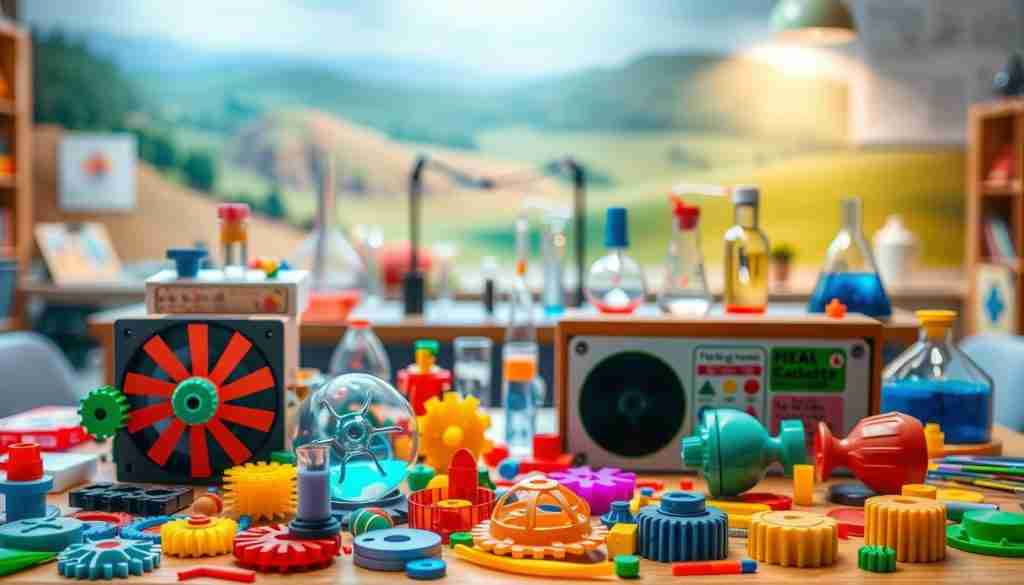
The KiwiCo Wind Play Lab turns breezes into lessons. Kids adjust fan speeds to send kinetic pom poms flying, discovering airflow patterns through trial and error. One parent laughed: “Our lounge became a weather lab – complete with ‘storms’ made from couch cushions!”
These tools excel at making abstract concepts tangible. Textured ramps teach friction differences, while colour-coded wind channels demonstrate air pressure. The challenge lies in predicting outcomes: “Will my parachute design float longer if I change the material?”
Quality kits include:
- Guided instructions for structured experiments
- Open-ended prompts for creative testing
- Multi-sensory materials like crinkly fabrics or smooth slopes
Take the Learning Resources Primary Science Sensory Tubes. Children fill them with leaves, beads, or water to explore natural forces. Shaking the tubes reveals how weight affects motion – perfect for mini engineers. Parents appreciate how these activities blend tech-free learning with giggles.
Through such play, children grasp cause-and-effect relationships instinctively. As one educator noted: “When a six-year-old explains lift using paper airplanes, you know the lesson stuck.” These experiences build scientific thinking without formal terms – just pure, curiosity-driven discovery.
Inspiring Marble Runs and Engineering Challenges
What happens when gravity becomes a playground for young minds? These clever construction projects turn basic physics into thrilling adventures. Kids become junior engineers, tweaking angles and testing theories to guide marbles through custom obstacle courses.
Designing and Testing Marble Run Creations
The Ravensburger GraviTrax Junior Jungle sparks creativity with magnetic track pieces and jungle-themed challenges. Children experiment with slopes, loops, and jumps to keep their marbles rolling. One Sydney parent shared: “Our living room floor became an engineering lab – complete with victory dances when runs succeeded!”
Popular kits encourage:
- Testing different materials (plastic, wood, foam)
- Adjusting track angles for speed control
- Adding obstacles like bells or tunnels for complexity
| Product | Key Features | Learning Outcomes |
|---|---|---|
| GraviTrax Junior Jungle | Magnetic connectors, themed challenges | Gravity principles, spatial planning |
| ThinkFun Gravity Maze | 60 puzzle cards, transparent towers | Logical reasoning, trajectory prediction |
Building Engineering and Critical Thinking Skills
These games teach more than physics. The ThinkFun Gravity Maze challenges kids to build paths that satisfy puzzle card requirements. As Adelaide educator Mark Davies notes: “Students learn persistence – if their first design fails, they analyse why and try new approaches.”
Families often bond over these projects:
- Parents help brainstorm solutions without taking over
- Siblings collaborate on multi-level designs
- Grandparents share real-world engineering stories
Whether creating simple ramps or elaborate spiral towers, these activities prove learning feels like play when things roll, drop, and clatter their way to success!
Innovative City Engineering and Design Sets
Imagine transforming a living room floor into a bustling metropolis where tiny architects solve real-world challenges. Modern construction kits let children design miniature cities while grasping urban planning basics. These tools blend imaginative play with practical skill-building – no hard hat required!
Practical Projects That Develop Real-Life Skills
The City Engineering & Design Building Set from Kidzinc turns playtime into urban development workshops. Young builders tackle projects like suspension bridges and skyscrapers using modular pieces. One parent chuckled: “Our dining table became a city council meeting spot – complete with debates about tunnel placements!”
These kits shine by teaching:
- Structural integrity through tower-building challenges
- Traffic flow management with movable road cards
- Environmental planning using parks and waterways
Instructional guides break complex concepts into bite-sized steps. Colour-coded cards show how real engineers approach problems, while open-ended prompts encourage creative solutions. As Sydney educator Mia Patel notes: “Students learn to iterate – their fifth bridge design often works better than the first!”
Beyond construction skills, these activities nurture:
- Collaboration during family building sessions
- Patience through multi-day projects
- Spatial awareness when visualising 3D blueprints
Whether crafting earthquake-resistant buildings or designing green spaces, children gain confidence in tackling real community challenges. And yes – those sturdy plastic pieces survive even enthusiastic bath-time testing sessions!
Ensuring Safety and Quality in STEM Toys
How can you tell if a building set teaches engineering or just makes a mess? Safety and durability separate quality educational tools from ordinary playthings. Trusted brands combine rigorous testing with clever designs that withstand enthusiastic use.
What Experts and Families Look For
Good Housekeeping’s lab tests reveal key markers of reliable products. The Snap Circuits Flight Deck, for example, uses smooth, rounded edges and secure battery compartments. One parent noted: “Our 9-year-old built a working fan without any loose parts – even after 50 rebuilds!”
Top-rated options share these features:
- Non-toxic materials certified by Australian standards
- Chunky pieces that prevent choking hazards
- Clear age labels matching skill levels
| Product | Safety Features | Parent Feedback |
|---|---|---|
| LEGO Gravity Drop | Interlocking bricks, no small detachable parts | “Survived 3 siblings’ play sessions intact” |
| VTech Activity Wagon | BPA-free plastic, volume control | “Buttons withstand daily pounding” |
| Learning Resources Code & Go Mouse | Rounded corners, washable surfaces | “Easy to sanitise for classroom use” |
Certifications matter too. Look for ISO 8124 compliance or ASTM F963 markings – these indicate thorough hazard assessments. As Melbourne safety inspector Dr. Emma Wu advises: “Check for third-party validation, not just manufacturer claims.”
Reviews highlight how thoughtful design prevents frustration. The LEGO Gravity Drop’s sturdy base keeps towers upright during experiments, while magnetic construction kits avoid sharp connectors. When tools work as intended, children focus on discovery rather than broken pieces.
Top Places to Buy STEM Toys in Australia
Finding quality educational tools doesn’t require a treasure map. Australian families have excellent options across physical stores and digital platforms. Let’s explore trusted sources that combine convenience with expert-curated selections.
Local Retailers and Trusted Online Shops
Kidzinc leads with award-winning products like the City Engineering Set, available both online and in their Sydney/Melbourne stores. Their staff provide personalised recommendations based on age and skill levels. For coding enthusiasts, Amazon Australia stocks exclusive robotics kits like the Learning Resources Code & Go Mouse with same-day delivery in metro areas.
Other reliable options include:
- Big W: Affordable building sets like Magna-Tiles with seasonal discounts
- Toymate: Hands-on science kits tested by educators
- Officeworks: Technology-focused tools with price-match guarantees
| Retailer | Specialty | Parent Tip |
|---|---|---|
| Kidzinc | Award-winning engineering kits | Free gift wrapping available |
| Amazon AU | Prime member robotics deals | Check “Warehouse Deals” section |
| Big W | Budget-friendly options | Price drop alerts via app |
Special Offers and Award-Winning Products
Look for seasonal sales aligning with school terms – many retailers offer 20% off coding tools during Tech Week. Learning Resources often bundles their Botley 2.0 robot with activity cards at Target. Exclusive online ranges like Amazon’s STEM Favourites list combine top-rated products with detailed video demos.
Pro shopping tips:
- Compare battery requirements (rechargeable vs disposable)
- Check age suitability labels against your child’s abilities
- Read detailed specs for piece counts/material types
Recent award winners like the Osmo Genius Kit (2023 Good Housekeeping pick) and Giggleway Circuits (Parent’s Choice Gold) feature prominently at these retailers. As one Canberra mum shared: “The staff at Kidzinc explained which robotics kit matched my son’s patience level – worth every cent!”
Conclusion
Turning playtime into skill-building adventures doesn’t require complex gadgets. The right tools – from coding robots to marble runs – spark curiosity while teaching problem-solving. Whether it’s constructing cities or mixing safe chemical reactions, these activities make abstract ideas feel real.
Age matters. A science kit for older children might involve circuitry, while younger ones thrive with magnetic blocks. As expert-vetted options show, quality design ensures safety and lasting engagement. Brands like Kidzinc balance fun with measurable learning outcomes.
Parents can trust products tested by authorities like Good Housekeeping. Look for kits that grow with your child’s abilities, offering fresh challenges as skills develop. Robotics sets or building projects not only entertain but build confidence in tackling real-world problems.
Ready to transform screen time into creative exploration? Start with one activity that aligns with your child’s interests. Watch as they discover the joy of learning through hands-on play – no textbooks required.